
How To Choose The Right Mouthguard
Updated: Feb 4
The Mouthguard Review participates in the Amazon affiliate partnership program. Please support this website by clicking the, Buy Now link to purchase a product recommended below. There is no extra cost to you. If you have purchased something through the site in the past, thank you! I really appreciate your support!

Mouthguards come in a variety of shapes, sizes, designs, colors and prices. When it comes time for an athlete to select a mouthguard for his/her specific sport, all of these options can be overwhelming and confusing. One of the most important tasks for an athlete in the offseason is to choose the correct mouthguard because different sports involve varying degrees of risk or contact, choosing the right mouthguard for his/her specific sport is extremely important.
There are many things to consider when shopping for a mouthguard. For instance, what sport do you play? Do you have braces? Are you prone to loosing your mouthguard? How old are you and do you require a youth or adult mouthguard? Do you have a large or small mouth? What is your budget? Do you desire maximum oxygen intake? Do you need to communicate frequently with your teammates? Do you prefer a flavored mouthguard? Do you like a mouthguard with a little bling? Do you want a certain color?

Some teams, leagues, organizations and clubs have specific requirements and require all participants to wear a mouthguard. The NCAA only requires 4 sports to wear a mouthguard. To be on there safe side, you should always check with your coach, league office, organization, club or even your dentist if your not sure of which mouthguard to purchase. Clear mouthguards have been banned from some leagues because referees can't decisively determine if an athlete is wearing a mouthguard. If an athlete has braces on their upper and lower teeth, some leagues require that you wear mouthguards that protect the upper and lower teeth. The regulations you need to be aware of will vary depending on where you live. For instance, if you live in Europe, all mouthguards must be CE certified. The CE mark is a declaration by the manufacturer that the product in question complies with the relevant EU(European Union) legislation that mandates:
* compliance with specific standards and requirements concerning product safety, environmental impact, consumer protection, etc; and
* the placing of a CE mark
Even if your team or league rules don't require you to wear a mouthguard during competition, you should do yourself and your teeth a big favor and wear a mouthguard.
The American Dental Association Recommends Mouthguards For The Following Sports
Basketball
Boxing
Hockey
Equestrian
Football
Field Hockey
Gymnastics
Inline Skating
Lacrosse
Martial Arts
Raquetball
Rugby
Track & Field
Skateboarding
Skiing & Snowboarding
Skydiving
Soccer
Surfing
Vollyball
Waterpolo
Weightlifting
Wrestling

HOW TO CHOOSE A MOUTHGUARD
1) Protection: According to the Academy Of Sports Dentistry, proper protection starts with a minimum thickness of 3 millimeters of material thickness in the impact zone and should cover the teeth in the arch and surrounding tissues. Sports that have a face mask like American football, ice hockey and mens lacrosse, where the frontal impact is guarded by the face mask, can have a thinner frontal profile, but feature more protection under the molars. Sports like field hockey, women's lacrosse, boxing, mixed martial arts, rugby, basketball etc... require more protection in the frontal zone to absorb impact from a stick, ball or elbow. Even though it seems like this information is outdated, as of 1/1/2021, this information is still on the Academy Of Sports Dentistry website. With the advancement in materials, from companies like SISU and Game On, mouthguards can be thinner and provide even greater shock obsobancy than traditional EVA mouthguards.

2) Snug Fit: A preferred mouthguard must have a snug fit and should never come loose or float around in your mouth because it will cause you to remain in a clenched position, trying to keep their mouthguard from falling out of their mouth, which in turn will contribute to fatigue and poor performance. A tight fitting mouthguard will increase your oxygen intake by remaining in your mouth and on your teeth which means you will have more endurance or stamina, more muscle strength, and lower blood pressure. All of these things will give you faster muscle recovery times which could help you perform better. The only acceptable way a mouthguard should come out of your mouth is by pulling it out yourself. With a tight fitting mouthguard you will be able to communicate with your team mates better. The before and after fitting picture above is what your mouthguard should look like after fitting. Notice how the material is formed around my teeth, this is what a tight fitting mouthguard should look like (pictured is the Makura Ignis Pro Mouthguard).
3) What sport are you participating in?: Because different sports involve different risks and potential for injury, this is very imperative. Refer to The Mouthguard Review blog articles which break down the best mouthguards for every sport.
4) Budget: Custom mouthguards can be very expensive for an athlete. If you want or need a custom mouthguard you can skip the middle man (the dentist) and get an in-home or mail-in impression kit. Check out my article All About Mouthguards for a list of reputable custom mouthguard companies. In my expert opinion, I don't believe that custom Mouthguards are better than ALL boil-n-bite mouthguards.
5) Size: When selecting a mouthguard, the size of your mouth will determine which mouthguard will fit you. All boil-n-bite mouthguards will expand to fit the arch of your mouth during the fitting process but may be too long or too short. A mouthguard should cover all of your teeth and some of your gums and should extend to at least the second molar but not past the second molar. If it extends too far back, past the second molar or extends into your soft palate, the mouthguard may cause you to gag.
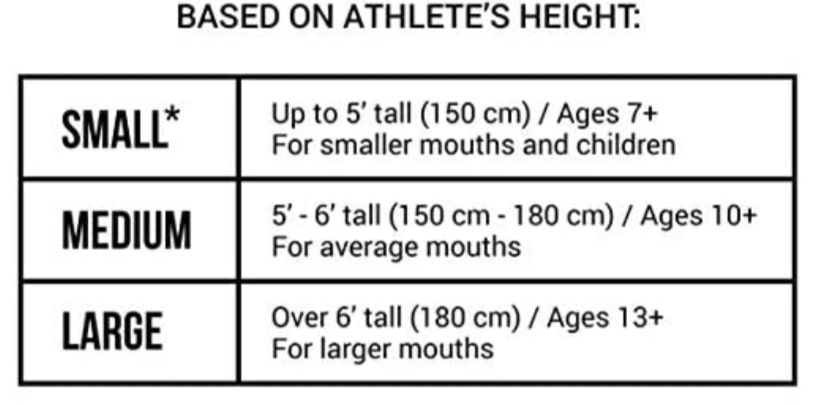
A great way, but not error proof, to pick the correct size mouthguard is to use SISU Mouthguards fitting chart to select whether or not you need Youth, Adult or even Small, Medium or Large sizes. Recent studies have shown that there is a direct correlation between your height and the size of your mouth. For a small mouthguard your height should be under 5' and for a medium sized mouthguard your height should be 5'-6' and for a large mouthguard your height should be over 6".
This sizing system is based on height and not the athletes age.
Sports dentists and health professional do not recommend store bought boil-and-bite mouthguards to their patients and athletic teams. Although recently, The American Dental Association gave their seal of approval to Game On Mouthguards. Its the only boil-and-bite mouthguard on the market to get this seal of approval. The Academy Of Sports Dentistry states that "care should be taken by the public when bombarded with clever marketing schemes, claims, and promotions by boil-and-bite mouthguard companies. I agree to a certain extent. Yes, boil-and-bite mouthguards have many negatives but so do custom mouthguards that dentists and health professionals fail to recognize. There are some really bad boil-and-bite mouthguards on the market just as there are really bad custom mouthguards and custom mouthguard companies.
THE MATERIALS AND INFORMATION IN THIS ARTICLE HAVE BEEN PREPARED OR ASSEMBLED BY THE MOUTHGUARD REVIEW AND ARE INTENDED FOR INFORMATIONAL PURPOSES ONLY AND ARE NOT A SUBSTITUTE FOR ADVICE FROM A LICENSED HEALTH-CAR PROFESSIONAL. YOU SHOULD NOT RELY SOLELY ON THIS CONTENT, AND THE MOUTHGUARD REVIEW ASSUMES NO LIABILITY FOR INACCURACIES. ALWAYS READ LABELS AND DIRECTIONS BEFORE USING A PRODUCT. SOME OF THE INFORMATION MAY BE DATED AND MAY NOT REFLECT THE MOST CURRENT EVENTS. I WROTE THIS ARTICLE MYSELF AND IT EXPRESSES MY OWN OPINIONS.


Comments