
All About Mouthguards
Updated: Feb 4
The Mouthguard Review participates in the Amazon affiliate partnership program. Please support this website by clicking the, Buy Now link to purchase a recommended product listed below. There is no extra cost to you. If you have purchased from the site int he past, thank you! I really appreciate your support!

The primary function of a mouthguard is to protect an athletes teeth from being chipped, fractured or knocked out from an accidental or incidental blow to your mouth. In addition to protecting your teeth, mouthguards act as a shock absorber to prevent the lower jaw from being jammed into the upper jaw. A proper fitting mouthguard can also protect the roots of an athletes teeth from being damaged, which could lead to other problems later on in life. For maximum protection, a mouthguard should cover at least the first molar of adult teeth and most of the root structure of each tooth.
Most athletes, parents and coaches underestimate the importance of a mouthguard. They would rather spend more money on shoes, socks and shirts. When purchasing a mouthguard it involves an extra expense that most athletes don't want to incur because they already spent more money than they should have on the things that won't protect them. For many athletes, the mouthguard is the last piece of sports equipment to be purchased .When you compare the cost of a mouthguard to the cost of not wearing one, any price you pay for a mouthguard should be seen as a bargain.
Here are some shocking statistics about dental injuries:
1) According to the Academy Of General Dentistry, an athlete is 70 times more likely to sustain damage to teeth when not wearing a mouthguard.
2) According to the American Dental Association (ADA), more than 5 million teeth are knocked out every year; many during sporting activities, resulting in nearly $500 million spent on replacing lost teeth every year.
3) According to the American Dental Association (ADA), more than 200,000 oral injuries are prevented each year by wearing a mouthguard.
4) According to The National Youth Sports Foundation (NYSSF), more than 3 million teeth would be knocked out in youth sporting events.
5) According to the US Centers For Disease Control, sports-related dental injuries account for more than 600,000 emergency room visits each year.
There are three different types of dental injuries that could occur during competition, that could also be prevented by wearing a mouthguard.
1) Avulsion- Dental avulsion is the complete displacement of a tooth and roots from its socket.
2) Fracture- A tooth fracture can range from minor (chipping) to severe (vertical, diagonal and horizontal fractures of the tooth and/ or root)
3) Luxation- A luxation occurs when the tooth is displaced, usually in a palatal/lingual or labial direction. This is where the tooth is still in the socket, but in a wrong or different position.
There are four types of mouthguards that can help prevent all the dental injuries listed above. From flavored mouthguards to lip guards, strapped and strapless, to boil-and-bite to custom, there are endless amounts of choices one the market today. All mouthguards have pros and cons, all very in different levels of price, style, protection, safety features and comfort.

Types of Mouthguards
1) Stock Mouthguard- This type of mouthguard is usually very inexpensive and comes pre-formed and ready to wear directly out of the package, although, I would recommend cleaning it first. Most of the time they don't fit that well. They can also be bulky, uncomfortable and make breathing and talking difficult. Even though this is true, I would consider some mouthguards that are made strictly for braces, stock mouthguards. This mouthguards are usually made out of silicone and don't fit tightly around an athletes braces. Check out Mouthguards For Braces post to learn more.
Pros + :
*Inexpensive
*Ready to wear(after cleaning)
*Readily available
*Can be worn with braces
Cons - :
*Available in limited sizes
*Don't fit well
*Inhibit speach
*Uncomfotable
*Inhibit breathing
*Bulky
*Can't adjust fit
2) Boil-And-Bite
This type of mouthguard has remained unchanged for 60 years or more. About 90% of all mouthguards used today are the boil-and-bite type.
The directions for fitting vary from manufacturer to manufacturer, but most require the mouthguard to be submerged into a pot of boiling water that softens the material of the mouthguard. The athlete then puts the softened mouthguard into his/her mouth and conforms it their teeth and gums all while gently biting down. The mouthguard is left in the athletes mouth until it cools down and solidifies. The boil-and-bite method of fitting a mouthguard is popular because its quick, easy and very affordable.
Advances in materials over the past few years have helped boil-and-bite mouthguards rival the fit of custom mouthguards.
Pros + :
*Relatively inexpensive
*Can be custom formed to the teeth
*Quick and easy to fit
*You don't need an impression
*Rivals fit of custom mouthguards
Cons - :
*Decreased protection if the mouthguard is "thinned" out during the fitting process
*Tend to be bulky
3) Custom
There are actually two different types of custom mouthguards available, A)Vacuum Formed and B)Pressure Laminated.
A custom mouthguard starts with an impression taken by a dentist, dental assistant or by yourself with an in-home impression kit. The person who takes the impression first fills the impression tray with impression material, then inserts the tray with impression material into the mouth and then you bite down gently. Once the impression material sets up according the manufacturer's instructions (usually a few minutes), the tray and impression material are removed from the mouth. Recent technology has eliminated the need for "traditional" impression taking procedures. Scroll down to Digital Impression Combined With 3D Printing to read more.
The next step is to pour a dental stone into the impression. The dental stone comes in a powder that when mixed with water, will harden after an hour or so. The hardened stone is then removed from the impression. In the dental world, we call this a model or mold of the patient or athletes teeth. Now the dental assistant or laboratory technician has an exact replica of the patient or athletes teeth to start making the custom mouthguard from.
Some dentists will have their dental assistant make the mouthguards right in their office with a machine called a vacuum former while other dentists will send the model or in most cases, just the impression to a dental laboratory to have the custom mouthguard fabricated. Custom mouthguards fabricated by dentists or dental laboratories represent only about 2-4 percent of todays mouthguard market. Make sure you ask which process your dentist will use to make your custom mouthguard. You have a right to know, after all, your spending a lot of money for this type of mouthguard.
A) Vacuum Formed Custom Mouthguard
Vacuum formed mouthguards provide a little more protection and possibly a better fit then boil-and -bite mouthguards because they are formed over a model or mold of the athletes teeth with a fairly inexpensive machine like the one pictured below. This type of mouthguard doesn't fit as tight as a custom pressure laminated mouthguard. Even though these types of custom mouthguards provide slightly more protection and a slightly better fit when compared to most boil-and-bite mouthguards, they are only made with a single layer of material. Because they are made of a single layer of material, they also cannot be customized with a logo or name in-between the layers of material.
Pros + :
* A little more protection than most boil-and-bite mouthguards
* Maximum comfort
* Increased oxygen intake
* Improved communication
* Can be made with a digital impression(some dentists don't have this technology)

Cons - :
* Expensive
* Time consuming to make
* Material inaccuracies
* If your dentist doesn't have digital impression technology you will have to get a "traditional impression", which for some people, can be unpleasant.
*May loose its shape and snug fit over time
* Fabricated with only a single layer of material
* Inconvenient (will take multiple trips to dentists office)
B) Pressure Laminated Custom Mouthguard
Pressure laminated mouthguards, if done correctly, are generally considered to be the best type of mouthguard combined with the highest level of protection. Every pressure laminated mouthguard can be customized and individualized by the sport an athlete participates in.
This type of mouthguard is fabricated using an expensive machine (the Drufomat Scan, pictured below), by a dental technician.

I used both this type of machine and a vacuum laminated machine, and I can attest to a big difference in the fit of the mouthguard. When using the pressure laminated machine, you can achieve a much tighter fitting mouthguard. Like a vacuum formed mouthguard, the pressure laminated mouthguard is formed over a model or mold of the athletes teeth. Pressure laminated mouthguards can be laminated with two or three layers of material under high heat and with high pressure. Computer controlled thickness of each layer ensures proper thickness.
Pros + :
* Extremely comfortable
* Maximum protection
* Increased oxygen intake
* Improved communicatioin
* Two or three layers of material for added cushion
Cons - :
* Expensive
* Time consuming to make
* Inconvenient ( will make multiple trips to dentist)
C) Digital Impression Combined With 3D Printing
This technique for frabicating a custom mouthguard uses digital scanning technology combined with 3D printing. The impression of the athletes teeth is captured with an intra-oral camera that basically takes several pictures of your teeth. The scanner looks like a small wand that is gently moved over the surface area of each tooth to capture every detail of the teeth and gums. This technique is way more pleasant than getting a "traditional impression."

The digital scan then uses the information to create a 3D image of the teeth and gums of the upper and lower arch. The digital file can then be sent to a 3D printer to create the model or mold of the athletes teeth. From there a vacuum formed or pressure laminated custom mouthguard is made. Most of the time, the dentist will have the intra-oral scanner and send the file to his/her dental laboratory. Some dental laboratories will even scan the impression that was sent from the dentist of the athletes mouth and then make a 3d model.
Another method that is in the near future and being worked on right now is the printed mouthguard. Yes, you read that right, printed on a machine from a digital impression. The cost of these types of mouthguards will still be very expensive because you will still have to go through your dentist, but is very convenient and less time consuming and labor intensive to fabricate. Also, this type of mouthguard would cut out the need for a printed model or a poured model with a traditional impression.
As of this post, I know of only two companies that offer this technology.
1) GRiTT 3D (Currently on INDIEGOGO)
D) Online Self Impression Kits
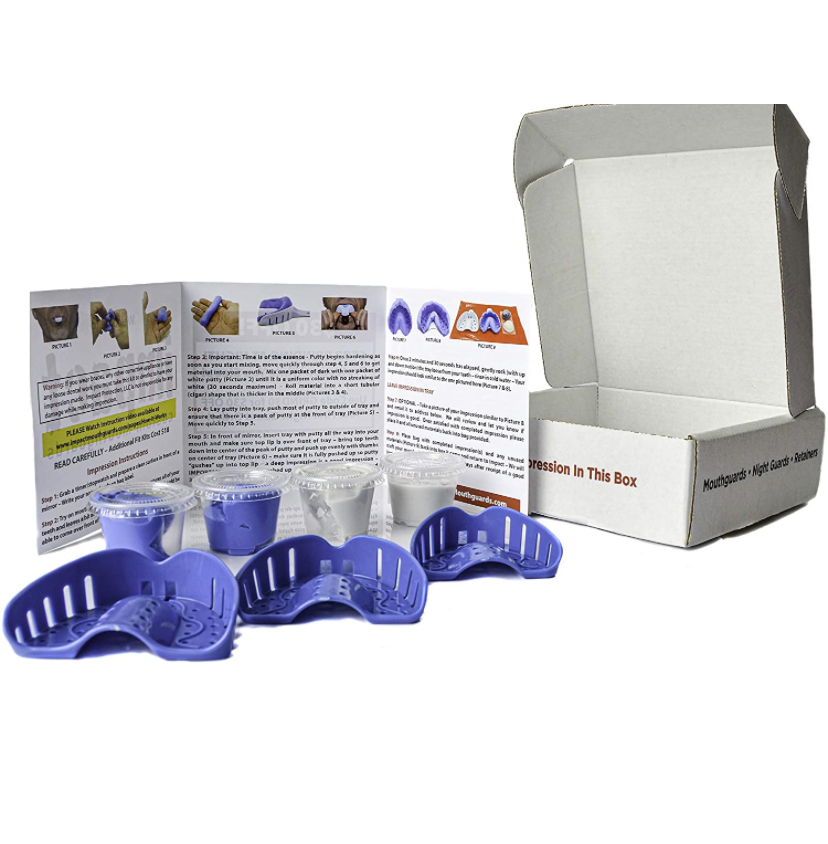
Some dental laboratories offer a "mail-in" custom mouthguard option to athletes. This option cuts out the middle man (the dentist), Which could save the purchaser hundreds of dollars. An athlete can purchase an in-home impression kit directly from the dental laboratory or even directly from Amazon. The kit will contain impression material and impression trays. The athlete mixes the impression material by hand (putty and catalyst), and rolls up the material into a "hot dog" shape and lines the impression tray with the material. The athlete then inserts the impression material and tray into their mouth. After you have it in your mouth you bite down gently. After the impression solidifies, its time to remove it from the mouth. You then send it back to the laboratory or where you bought the impression kit from. After the dental laboratory finishes the mouthguard to your specs, the laboratory will send it back too you.
Taking an impression is a delicate process and like anything, requires some experience. Like everything you try for the first time, it won't be perfect, unless your lucky. Not only does the human error element come into play, impression material defects such as voids, air bubbles, distortion or improper setting also comes into play. The good news is, when you send your impression to the dental laboratory, an experienced technician will and should look over the impression to make sure there aren't any defects or irregularities. In most cases, the dental laboratory will just send you a new in-home impression kit.
Pros + :
* Saves time
* Saves Money
* Can Customize with team logo
* Impression taken in the comfort of your own home
* Because its a custom mouthguard, you get all of the advantages listed above
Cons - :
* Taking your own impression can be difficult
* May take several attempts to get an "acceptable" impression
* Increased possibility of impression-taking errors
* Even tough your cutting out the dentist, the custom mouthguard is costly
* Can take up to a week to get your completed mouthguard
Top Custom (mail in) Mouthguard Companies
* Impact Buy Now
* Damage Control
* Gladiator Buy Now
* Guard Lab
* Sentinel Buy Now
* Mouthpiece Guy
* Sportsguard
*Sporting Smiles Buy Now
* Because it is difficult to rank custom mouthguard companies, I am providing you with the most reputable companies that I know of. There a tons of laboratories that make custom mouthguards (mainly directly to dentists), but not all of them have in-home impression kits.
THE MATERIALS AND INFORMATION IN THIS ARTICLE HAVE BEEN PREPARED OR ASSEMBLED BY THE MOUTHGUARD REVIEW AND ARE INTENDED FOR INFORMATIONAL PURPOSES ONLY AND ARE NOT A SUBSTITUTE FOR ADVICE FROM A LICENSED HEALTH-CAR PROFESSIONAL. YOU SHOULD NOT RELY SOLELY ON THIS CONTENT, AND THE MOUTHGUARD REVIEW ASSUMES NO LIABILITY FOR INACCURACIES. ALWAYS READ LABELS AND DIRECTIONS BEFORE USING A PRODUCT. SOME OF THE INFORMATION MAY BE DATED AND MAY NOT REFLECT THE MOST CURRENT EVENTS. I WROTE THIS ARTICLE MYSELF AND IT EXPRESSES MY OWN OPINIONS.


Comments