
Do Mouthguards Or Protective Head Gear Prevent Concussions?
Updated: Feb 4
The Mouthguard Review participates in the Amazon affiliate partnership program. Please support the website by clicking the, Buy Now link to purchase a product recommended below. There is no extra cost to you. If you have purchased something from the site in the past, thank you! I really appreciate your support!

Mouthguards are an important piece of athletic equipment that provides protection to your teeth. Mouthguard technology has improved drastically over recent years with major changes not only in customization but also with several different new material types and different levels of thickness. Today, boil-and-bite mouthguards are thinner, safer and more comfortable to wear.
One of the most commonly asked questions by athletes and parents is "will a mouthguard or a helmet prevent a concussion?" Many experts in the past argued that mouthguards helped prevent concussions. The evidence for this statement is limited. As of the date that this article was published, only two articles support the claim that mouthguards prevent concussions. A study published by the Academy of General Dentistry in 2014 concluded that high school football players wearing store-bought mouthguards were more than twice as likely to suffer mild traumatic brain injuries (MTBI)/ concussions than those wearing custom-made mouthguards. When you read that statement, it pushes you to believe that "store-bought" means ALL store-bought mouthguards are bad. And what do they mean when they mention "store-bought"? Are they talking about stock mouthguards, boil-and-bite or both? I think that their study or statement is very misleading. After all, look at who wrote the article, dentists, and guess what kind off mouthguards they sell, custom made mouthguards. Other experts would argue that there is no evidence that mouthguards and helmets prevent concussions. In a recent Canadian study by the Coming School of Medicine and Sport Injury Prevention Research Center at the University of Calgary. When researchers looked to see if the type of mouthguard made any difference, they found that off-the-shelf versions were tied too a 69% reduction in concussion risk compared to no mouthguard. Custom-fit mouthguards made by a dentist were linked to a 49% risk reduction."The current study is interesting from a cost standpoint too, said Dr. Creighton, "custom mouthguards which are significantly more expensive, were not shown to be associated with lower concussion rate compared to off-the-shelf mouthguards." Dr. Andrew Creighton is an an assistant attending physiatrist at the Hospital for Special Surgery in New York City and a professor of clinical rehabilitation medicine at Weill Cornell Medical College and was not involved in the Canadian study. Scientist have not reached an agreement on how the results of impact absorption tests relate to concussions. On August 16, 2012, the Federal Trade Commission announced a settlement prohibiting mouthguard manufacturer, Brain-Pad from making claims that its product reduces the risk of concussion.
Check out this blog pst by SISU Mouthguards (Do Mouthguards And Helmets Prevent Concussions?). They demonstrate how the brain sustains injury within the skull using an egg.
Even though helmets and mouthguards prevent injuries to the head and teeth, they do little to stop internal trauma caused from a concussion. Football helmets may actually give a football player a false sense of security and promote them to act more reckless and aggressive. Have you ever watched a football game where a player leads with his head to make a tackle?
Because there are no acceptable international standards for mouthguards, it makes for a very difficult time when comparing studies. These studies can be misleading because of the types of mouthguards they use in the study. Custom-fitted mouthguards are of course going to be, in theory (if done correctly), better than most boil-and-bite mouthguards. Several boil-and-bite mouthguards on the market today, match or come very close to all of the benefits that custom-made mouthguards have.
According to Jan Akervall, MD, PHD, co-founder and inventor of SISU mouthgiuards,
"with SISU mouthguards being 30-50% stronger than conventional mouthguards, you may think that the shock absorbing properties of the mouthguard would stop forces that transfer to the brain. Unfortunately, thats not true. Its not the case for SISU and its certainly not true for any other mouthguard." The Department of Defense (DoD) recently asked SISU mouthguards to investigate if a SISU mouthguard or any mouthguard could help soldiers protect their brains from concussions and traumatic brain injury. The research was performed at Wayne State University biomechanical laboratory. The report found that there is no evidence that a mouthguard can prevent concussions.

Whether you choose a custom-fitted or a boil-and-bite mouthguard to protect your teeth, it should fit properly. According to Richard Knowlton, DMD, MAGD, the 2016 US Olympic Team dentist, "A properly fitted mouthguard should retain a space between the end of the jaw, the condyle, and the temporal bone in the temporomandibular joint." A properly fitted mouthguard creates a separation of the condyle that some researchers believe may reposition or align the lower jaw to absorb , dissipate or reduce concussive forces. Dr. Knowlton believes when an athlete is hit in the jaw, the energy that is created from the impact can travel to the brain, which can cause injury. Some dental experts believe that if you have a mouthguard with the proper thickness ( 3mm or more in the posterior, occlusal or biting surface) that will create space in the temporomandibular may help dissipate the energy before it travels to the brain, which could in the least, lessen the damage. Dr. Knowlton does acknowledge that additional studies need to be conducted.
For the first time in its history, the National Football League (NFL) decided to start banning specific football helmets starting in 2018. As of August (2018), 10 helmets have been banned, however, if a player wore one of the banned helmets in 2017, they would be able to wear the same helmet in the 2018 season. None of the players would be allowed to wear them after the 2018 season. The NFL, in collaboration with the National Football League Players Association (NFLPA), through their respective appointed biomechanical experts, annually coordinate extensive laboratory research to evaluate which helmets best reduce head impact severity. Check out the laboratory tests from the NFL
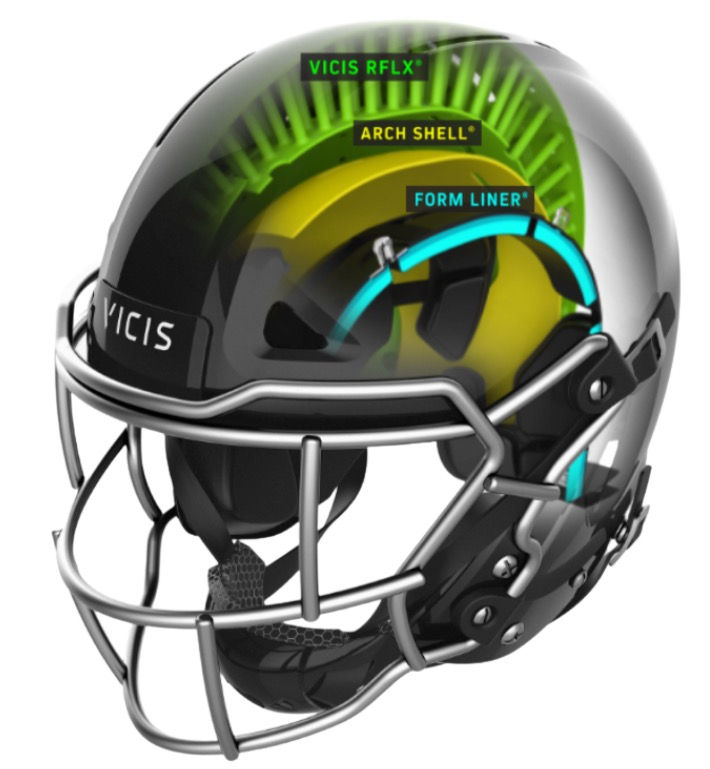
Concussion prevention research has recently helped launch a new football helmet manufacturer. The VICIS football helmet. The company was founded in 2013 and is culmination of a 3-year, $20 million research and development effort led by some of the worlds leading athletes, engineers and neurosurgeons to create a safer football helmet. The Zero 1 VICIS helmet has multiple layers that work together to slow, impact forces. The helmet has a soft or deformable outer shell, unlike most helmets that have a hard outer shell, and a layer of bendable columns, called the reflex or RFLX layer, on the inside of the helmet designed to mitigate collisions from multiple directions. There is also a thin, hard shell named the ARCH Shell on the inside of the helmet to protect the skull from fracture. The first VICIS helmet became available to the public in 2017. More than 100 NFL players and thousands of high school football players. They have over 400 high schools and more than 20 college teams that wear the helmets including the Notre Dame football team. Now the company is expanding its ingenuity to the battlefield. VICIS recently signed a contract with the Unite States Army to redesign pads inside the army helmets. VICIS also has aspirations of branching into other sports like hockey and lacrosse. The cost of the VICIS helmet has gone from an original price tag of $1,500, which was about 4 times as much as competitors helmets, down to about $950 in just one year. As of 2020 the price remains at $950. Buy Now
As of the posting of this article, mouthguards and especially helmets have not definitively been proven to prevent concussions. There is no way to stop the brain from moving around inside the skull. Helmets can prevent skull fractures and face injuries but more than likely can't prevent concussions. The debate still wages on whether or not mouthguards can prevent or minimize concussions. If they don't prevent concussions I think we can all agree that they can dissipate a hard impact that could travel to the brain.
THE MATERIALS AND INFORMATION IN THIS ARTICLE HAVE BEEN PREPARED OR ASSEMBLED BY THE MOUTHGUARD REVIEW AND ARE INTENDED FOR INFORMATIONAL PURPOSES ONLY AND ARE NOT A SUBSTITUTE FOR ADVICE FROM A LICENSED HEALTH-CAR PROFESSIONAL. YOU SHOULD NOT RELY SOLELY ON THIS CONTENT, AND THE MOUTHGUARD REVIEW ASSUMES NO LIABILITY FOR INACCURACIES. ALWAYS READ LABELS AND DIRECTIONS BEFORE USING A PRODUCT. SOME OF THE INFORMATION MAY BE DATED AND MAY NOT REFLECT THE MOST CURRENT EVENTS. I WROTE THIS ARTICLE MYSELF AND IT EXPRESSES MY OWN OPINIONS.


Comments